帝都
梨花映村晚 春色秀满园_我的网站

A | “开犁啦!”随着一声清脆的声响,4月20日9时30分,兴城市碱厂满族乡的《四季村晚》春季专场在蒋家村举行。
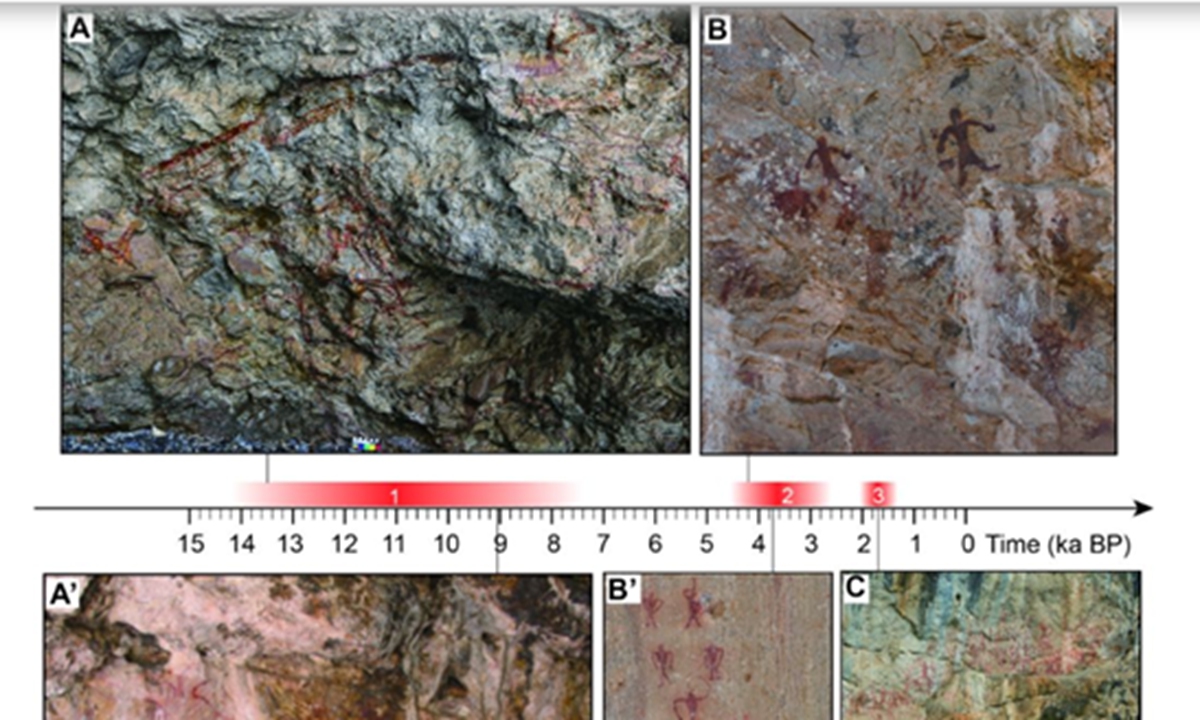
Chinese researchers have obtained the first absolute dates for rock paintings at the Mangguan rock art site in Southwest China's Yunnan Province, pushing the known history of rock art created by prehistoric settled communities in the region back to about 4,220 years ago. The paintings also suggest cultural interactions more than 4,000 years ago between Southwest China and civilizations along the Yellow and Yangtze rivers, as well as possible exchanges with neighboring parts of Southeast Asia, including present-day Myanmar, Thailand and Vietnam, a member of the research team told the Global Times.
The Yunnan Provincial Institute of Cultural Relics and Archaeology, in collaboration with Nanjing Normal University and other institutions, have recently made a significant archaeological breakthrough. Through systematic surveys and uranium-thorium (U-Th) dating at the Mangguan site in Gengma county, the research team obtained the first absolute dates for the site's rock paintings, tracing rock art created by prehistoric settled communities back to around 4,220 years ago.
The findings were recently published in the international journal Journal of Archaeological Science: Reports.
The Mangguan rock paintings represent one of the best-preserved prehistoric rock art sites in Yunnan. The research team presented high precision U Th dating of carbonate accretions that stratigraphically overlie the painted motifs at the Mangguan site, according to the paper published in the journal.
The dating results show that carbonate deposits overlying a human figure yielded a corrected age of 4,240 ± 19 years before present, confirming that ancient people living in the region had already produced mature figurative art at least 4,220 years ago, Wu Yun, first author of the paper and an associate researcher at the Yunnan Provincial Institute of Cultural Relics and Archaeology, was cited by the Xinhua News Agency report as saying.
Dating results from 11 samples taken from different motifs clustered between about 3,907 and 3,056 years ago. By comparison, the Cangyuan cliff paintings had previously been dated to roughly 3,800 to 2,700 years ago. The Mangguan paintings are therefore significantly older, filling an important chronological gap in the region's artistic record before the Cangyuan phase.
Shao Qingfeng, corresponding author of the paper and a professor at the School of Geography at Nanjing Normal University, told the Global Times that previous estimates dated the Mangguan rock paintings to a little over 3,000 years ago based mainly on imagery and comparisons with similar regional sites. Using microsamples of secondary carbonate deposits overlying the paintings, researchers have now obtained a precise minimum age of about 4,220 years before present without damaging the rock art.
The findings and the establishment of this chronological framework not only strengthen the archaeological foundation for studying rock art in Southwest China, but also provide a direct reference for rock art sites across Southeast Asia that have yet to undergo systematic dating, Shao said.
The findings may also challenge long-held perceptions of Southwest China around 4,200 years ago - roughly the era of the Xia Dynasty (c.2070 BC-C.1600 BC) - and help fill a key gap in understanding the pluralistic yet integrated development of Chinese civilization.
Shao said that while academic research has traditionally focused on the Yellow River and Yangtze River basins as cradles of early Chinese civilization, sites such as Mangguan and Cangyuan show that stable and culturally active communities also thrived in mountainous Southwest China. The newly established rock-art chronology brings an artistic dimension to the broader narrative of China's enduring cultural development.
Moreover, stylistic similarities suggest that Southwest China maintained exchanges with the Yellow River and Yangtze River regions and with early societies in Southeast Asia, providing material evidence of cross-regional interaction more than 4,000 years ago.
。在两个小时的时长里,草根表演爱好者用质朴的声音、舞蹈,歌唱祖国、赞美家乡。几百名游客或随声应和,或在附近的大棚里采摘新鲜水果,到处都是其乐融融、蓬勃向上的景象。

B | 开梨仪式。 近年来,在推进乡村振兴的过程中,当地党委政府科学谋划、有的放矢、稳步推进,利用碱厂水库、万亩梨园、设施农业等资源优势,打造了红山谷景区、干字碑观光区、四季采摘休闲场所等。

C | 农业与旅游业完美结合,取得了良好成效,老百姓的腰包越来越鼓。

D | 物质生活提高的同时,当地党委政府敏锐观察到,老百姓对精神生活的向往也逐年提升。在上级部门大力支持下,从去年开始,该乡因地制宜、挖掘潜力、节俭办会,切实了解老百姓的精神追求,用看得懂、瞧得真、领得悟的艺术形式表演给他们看。由此,《四季村晚》应时而生。

E | 《四季村晚》春季专场表演现场。 顾名思义,《四季村晚》分春夏秋冬四个季节,其中,春季表达的主题是春耕,谷雨这天,大地真正回暖,从这一时刻开始,村民即将耕种,希望的种子,也即将破土,长成郁郁葱葱的庄稼;夏季是田间管理时节,农闲时村民或一展歌喉,或舞姿翩翩,最朴素的身影,倒映在田间、小溪,组成一幅幅曼妙的图画;秋季是丰收的季节,梨满枝、粮满仓、果满棚,村民用生动的肢体语言,表达丰收后的喜悦心情,同时也流露出浓浓的待客情怀;红山谷的水资源非常丰富,到了冬季,这里的冰雪、冬捕深受游客喜爱,村民积极组织、参与,用最喜闻乐见的艺术表达方式,唱出对冰雪的热爱,舞出建设和美乡村的深情。

F | “电视上的节目虽然很好,但总感觉跟咱有距离。

G | 自从乡里搞这个《四季村晚》,我场场不落。不耽误农业生产,节目很接地气。不仅丰富了老百姓的业余文化生活,也增进了乡亲们的感情,打心眼儿里高兴。

H | ”74岁的白庙子村村民王芝国说。 数百名观众观看《四季村晚》。 春风阵阵舞翩跹,春意融融满人间。在举办《四季村晚》期间,很多村民将自家的玉米面饺子、年糕、山野菜、笨鸡蛋及时令棚种水果、蔬菜端到会场附近,游客纷纷购买,都夸赞乡野间的食物表面看着粗糙,实则价钱便宜、味道香醇,且有利于健康。 “这个时节,梨花正旺,春耕正浓。通过村晚秀出村民风采、营造和谐氛围,反映人民群众精神新风貌、乡村振兴新气象。同时,通过不断挖掘自身旅游资源,将人文融于自然,把文化和旅游相结合,向外界展示推动乡村振兴的新思路、新举措、新形象。”碱厂满族乡党委书记陆一平说。
Current article:http://2kz.xiadiaosengchengcun.shop/list_eq4/58sme0.html
Published on:02:58:14


